- Playing For Doubles
- Posts
- Stop Trying To Predict The Future
Stop Trying To Predict The Future
Why The Best Investors Focus on Resilience and Optionality Instead

Ahmad Jivraj
January 15, 2026
If you like this article, please share it with a friend. Thanks!
In 2022, I watched Meta lose 75% of its value.
But I didn’t sell.
Not because I’m a contrarian for sport, but because I asked myself two questions:
Can this company survive genuine catastrophe?
And does it have shots on goal that aren’t priced in?
The answers were yes and yes.
Sure, Reality Labs was bleeding money. But their advertising business was still printing cash. IG, WhatsApp, and FB Marketplace monetization provided the optionality. Eighteen months later, the stock was up several-fold.
This experience crystallized something I’d been thinking about for years.
Most investors spend their energy trying to predict the future, building elaborate models, obsessing over quarterly guidance, convincing themselves they know exactly how things will unfold.
But I’ve learned that’s a losing game.
The future has a way of humbling even the smartest analysts.
The question isn’t whether we can predict what happens next, but rather, whether a company can survive and thrive regardless of which future actually arrives.
This is why I’ve come to believe that Resilience and Optionality are two of the most important qualities to identify when buying a stock.
If you’re new here, I share “buy-and-hold portfolios” designed to double in 3-5 years. My investment approach is simple: find the best stocks I can and let them sit for years. We incur no costs with such a portfolio, and it’s simple to manage.
On Resilience: The Emergency Fund Principle
Here’s an analogy that changed how I think about investing.
Imagine two people, both earning $150,000 a year.


What Resilience Actually Means
Resilient companies are not optimized for maximum short-term returns.
They’re optimized to survive and adapt to changing conditions.
A resilient company can weather a recession without existential crisis.
It has the balance sheet to absorb shocks.
It operates in a way that competitors, even well-funded ones, struggle to replicate.
When the environment turns hostile, resilient companies don’t just survive, they often emerge stronger, taking share from weaker players who couldn’t make it through.
Resilience looks inefficient until it doesn’t. Why keep so much cash? Why not leverage up? Why maintain that buffer? But when the ground shakes, you understand why.
The Power of Optionality
Optionality is the flip side.
It means a large potential payoff from a relatively small investment.
Venture capitalists understand this intuitively.
They know most investments will amount to nothing.
But they also know that a few big winners will more than compensate for all the disappointments.
The best management, the most sophisticated plans, ample funding: none of it guarantees success. Sometimes the least plausible bets are the ones that break through.
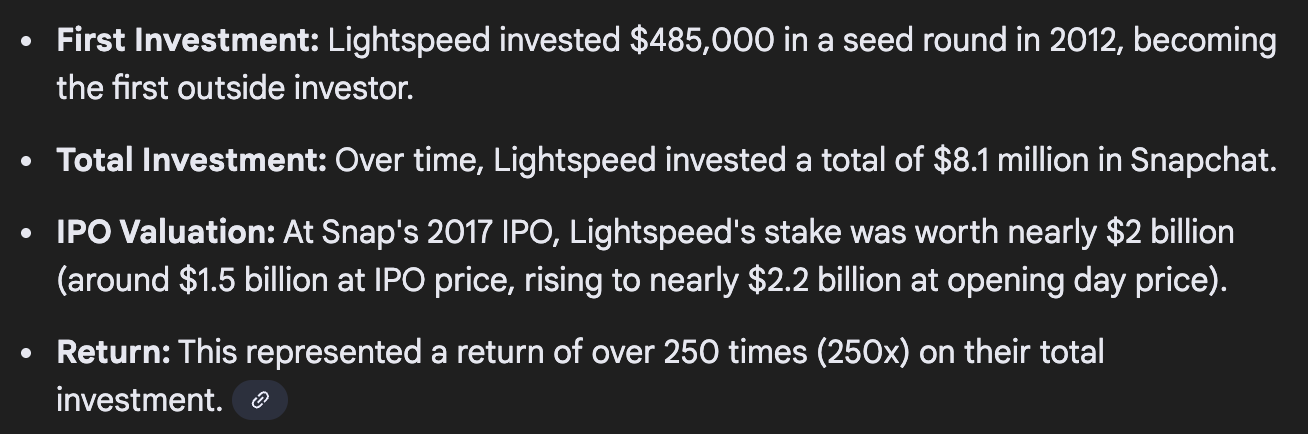
A great example is Lightspeed Venture Partners’ investment in Snapchat, where a mere $8 million (clearly a low-conviction bet considering how big their fund was) turned into $2 billion.
As individual investors, we can apply the same thinking.
We don’t need to predict exactly which product line will take off, which market will explode, or which technology will win.
We just need to own companies where multiple paths could lead to outsized returns.
Investment Categories
Here’s one way I think about categorizing investments.

1. The Sweet Spot: When Both Qualities Are Present
The most powerful investments combine Resilience and Optionality. Lets look at a few examples:
Amazon
Alphabet
Intel
Alibaba

Amazon: The Template
Consider Amazon in 2014.
The core retail business was a fortress: massive distribution network, unmatched customer obsession, the ability to operate at margins competitors couldn’t stomach.
That was the resilience.
But there was also this small, fast-growing segment called AWS that most investors ignored, misunderstood, or undervalued.
That was the optionality.
The resilient retail business funded the investment in cloud infrastructure.
It gave Amazon the staying power to keep building.
And then the “optional” bet became the profit engine, eventually worth more than most standalone companies in the world.
The resilient core funded the optionality.
The optionality transformed the entire business.
This is a great template to look for: companies where the base business provides a margin of safety, and the upside comes almost “for free.”

Alphabet: The Cash Machine With Moonshots
Alphabet is another textbook example that follows the above template.
Google Search is one of the most resilient businesses ever created: a toll booth on the Internet.
Every day, billions of queries flow through, and Google takes a cut of the advertising dollars that follow.
The margins are extraordinary, the competitive position is nearly unassailable, and the cash generation is relentless.
But Alphabet doesn’t just sit on that cash:
They fund Waymo, which could dominate autonomous vehicles.
They fund DeepMind, which is pushing the boundaries of AI research.
They’re fund Google Cloud to compete with AWS and Azure.
The resilient core throws off enough cash to fund dozens of new shots on goal.
If even one or two hit, the returns could be transformational.
And if none of them hit? The search business alone justifies owning the company.

Intel (Current Bet): Legacy Business + Foundry Optionality
Intel is a live implementation of the above template in my portfolio.
On September 11, 2025, I shared 5 ways to double your money with Intel. All 5 have doubled.
The resilience:
Intel still holds 70-80% of the client PC market and over 50% in servers. When I first wrote about Intel, these legacy businesses alone justified the stock price.
The optionality:
TSMC has nearly 70% market share in chip manufacturing, but major customers like Nvidia and Amazon can’t afford single-source dependence. Intel is the only viable Western alternative. And the U.S. government has made domestic semiconductor manufacturing a strategic priority (see America’s AI Action Plan).
Intel is too important to fail.


Alibaba (Current Bet): E-commerce + Cloud + AI
I first mentioned Alibaba in summer 2024.
It was a 15% bet in Coffee Can 13 (11% stock, 4% options). This has been a homerun so far. In just over a year, the stock is up 2X, and the options 5X.
The resilience:
The core e-commerce business in China provided resilience.
Taobao and Tmall were dominant players in Chinese online retail. The logistics network was massive. The ecosystem was deeply entrenched in how Chinese consumers shop.
Yes, there were competitive risks. But the valuation and free cash flow generation were compelling.
The optionality:
The return and focus of founding team members, plus Alibaba Cloud, plus AI.
2. Pure Optionality Bets
Not every bet in a portfolio needs resilience.
Some can be pure optionality bets.
I sometimes call these “Seed Investments in the Stock Market.”


Let’s be honest: Rivian doesn’t have a resilient business today. They’re burning cash, scaling production, and competing against well-funded incumbents.
The base case is not comfortable.
But the optionality is significant.
Rivian has a chance to become a major player in electric vehicles. They have a partnership with Amazon for delivery vans. The R2 platform could expand their addressable market dramatically. Their software licensing deals could create billions in new revenue streams.
If Rivian succeeds, it could easily 5x or 10x from current levels.
That’s the nature of pure optionality bets: you size them appropriately and let the math work in your favor across a portfolio.
3. The Unproductive Middle
There’s a third category of companies, and I try to avoid them, is the unproductive middle.
These are companies that are neither resilient nor optional.
They don’t have the stability to survive real stress, but they also don’t offer the asymmetric upside to justify taking the risk.
They’re just kind of... there.
Mediocre balance sheets. Mediocre competitive positions. Mediocre growth prospects.
Think about legacy retailers stuck between Amazon and the discount chains.
Mid-tier software companies with decelerating growth and no moat.
Industrial businesses with no pricing power and cyclical exposure.
The unproductive middle is where capital goes to die slowly.
I’d rather own a company with genuine resilience, or a company with genuine optionality (ideally both) than something stuck in between.
The Framework in Practice
Balancing Resilience and Optionality means you don’t have to be right about the future.
You just have to be positioned for it.
When you build a portfolio around this framework, you’re not trying to predict which specific outcome(s) will materialize.
You’re acknowledging uncertainty and positioning yourself to benefit regardless.
The resilient positions protect your downside.
The optional positions create asymmetric upside.
Together, they can create magic.
Do You Agree?
Does this framework resonate with how you evaluate investments?
Which companies do you believe embody both Resilience and Optionality?
Leave a comment below or reply to this email.
Happy Investing!
If you like (❤️) this article, please do share it with a friend. Thanks :)
Disclaimer: This is not investment advice.