- Playing For Doubles
- Posts
- The Path To 100% Portfolio Returns
The Path To 100% Portfolio Returns
7 Replicable Lessons From 9 Winning Portfolios

Ahmad Jivraj
January 22, 2026
If you like this article, please share with a friend. Thank you!
Anyone can get lucky, and buy a winning stock.
What I’ve tried to demonstrate over the past ~7 years is that it’s possible to consistently design, buy-and-hold market-beating portfolios.

Since April 2019, I have shared 16 Coffee Can portfolios.
Of the 11 that have completed their 3-year holding periods (note: 5 are still active):
9 beat the S&P 500, averaging +144%
2 lost to the market, averaging -36%
Total average return across all 11 completed portfolios was ~+111%.
All 5 currently active portfolios are up >40% on average, so far.
This was the result of a repeatable process: one built on academic research, behavioral discipline, and a few timeless investing principles.
Today, I will break down the 7 factors that drove these returns: None require special access, insider knowledge, or market timing genius, and all are within your control.

Coffee Can 3 was constructed during the depths of the covid lows. In just 3 years, it returned almost 5X. Fear creates the best entry prices....
Lesson 1: You Need One Breakout Stock
“You make more from your winners than all your losers combined”
Every single Coffee Can portfolio that returned >100% had at least one breakout stock that returned at least 200%.
The Academic Foundation: Professor Hendrik Bessembinder’s research has taught us that only 4% of stocks are responsible for the large majority of the stock market’s net wealth creation.
What does this mean for us? The big money comes from a few big winners.
If we sell our winners early, which is exactly what our instincts tell us to do, we eliminate our exposure to the only stocks that actually matter.
Here’s why this is important: A stock can go up 200%, 500%, 1000%…
But it can only go down 100%.
This asymmetry is our edge.
With the coffee can approach, we’re not trying to avoid losers.
We’re aiming to own the winners and hold them long enough for the magic to happen.
Lesson 2: Select Well, Invest In Mavericks
“Winners keep winning”
Here’s a question I’ve often asked: How many home runs did Babe Ruth hit?
Most people who follow baseball can usually guess a close enough number.
But, no one seems to know how many times he struck out.
When you hit that many home runs, it doesn’t matter.
Similarly, in investing, what matters is not how many times you fail, but whether you hold on to the big winners.
Finding big winners requires a systematic approach to selection.
I call my approach “Investing in Mavericks: Approaching Stocks Like Venture Capital”.

Mavericks are special companies: They don’t just win once, they keep winning. Network effects get stronger. Switching costs get higher. Competitive moats get wider.
Our job is to identify them as early as we can, and hold on.
You can read more about Mavericks here.

Lesson 3: The Mandatory 3-Year Hold
“The stock market is a device for transferring money from the impatient to the patient” -Warren Buffett
The mandatory 3-year hold isn’t a constraint. It’s the strategy’s greatest edge.
It eliminates the single biggest destroyer of investor returns: emotional decision-making.
The Behavior Gap Is Real: DALBAR, a financial research firm, has studied investor behavior for over 30 years. Their findings are consistent and damning: The average investor has now underperformed for 15 consecutive years.
This gap isn’t caused by fees, bad stock picks, or lack of information. It’s caused by behavior:
Buying high during euphoria,
Selling low during panic, and
Touching your portfolio too often.
As Charlie Munger said, “The big money is not in the buying and selling, but in the waiting.”
The Coffee Can approach forces you to wait.

It’s not optional.
And that’s exactly why it works.
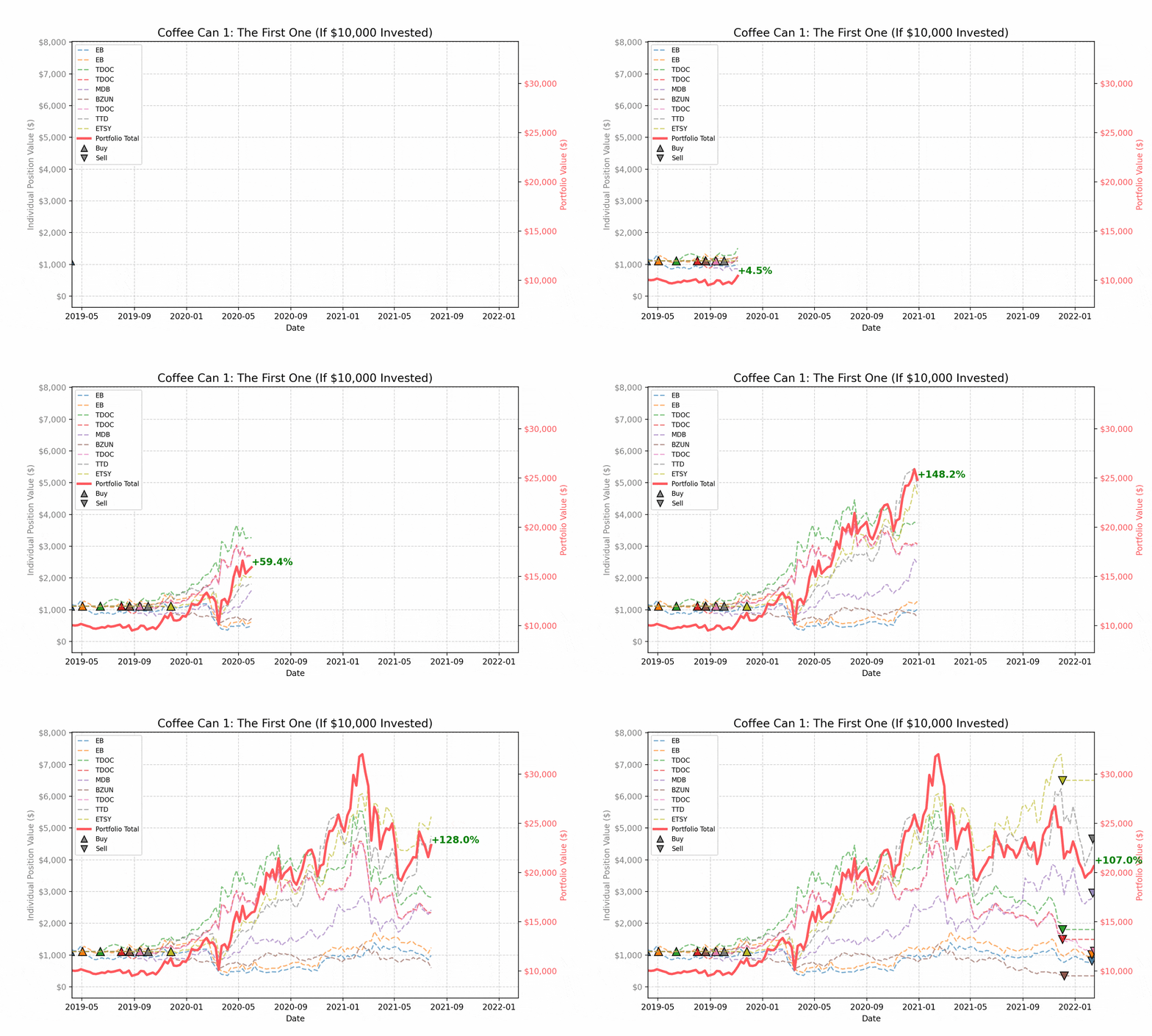
See that V-shape in March 2020? That was covid. The portfolio dropped significantly. Investors who panic sold missed a 107% total return. This is the power of holding.
Lesson 4: Timing Matters Less Than You Think
“The best time to plant a tree was 20 years ago. The second best time is now.”
“But what if I buy at the top?”
This is the fear that keeps us on the sidelines.
But it’s largely irrational.
Look at rolling 5-year periods on the S&P 500 since 1926:
88 out of 94 periods (93%) had positive outcomes
Only 6 outcomes were negative, and 3 of those were during the Great Depression
The most common return was 15-20% (yes, read that again).

The data on 3-year periods is similar.
You can’t predict whether you’re buying at a peak or a trough.
But you CAN however, commit to building at least a few Coffee Cans, over a few years, and give them time to actualize.
If you build one Coffee Can at a bad time, it might underperform.
If you build multiple Coffee Cans, say one every 6 months, over a few years, the timing noise washes out and the process takes over.
Think of it like dollar-cost averaging, but for entire portfolios.
You can’t control when the market goes up or down. You CAN control:
What stocks you select
How long you hold them
Whether you panic sell
Whether you keep building new Coffee Cans
Control what you can control.
Let time do the rest.
Lesson 5: Build Concentrated Portfolios
“Diversification is protection against ignorance.” — Warren Buffett
Building a diversified portfolio is one of the most sacred beliefs in investing.
But if you own say, 50 stocks, you’re buying the illusion of safety while guaranteeing mediocrity.
Don’t forget that your downside, no matter how many stocks you buy, is always 100%, but your winners in a large diversified portfolio get diluted into irrelevance.
Peter Lynch called this “di-worsification.”
It’s hard enough to capture a multi-bagger. When we do, we want it to produce a meaningful outcome, not just at the individual position level, but at the portfolio level.
I learned this the hard way.
I was lucky enough to capture a 10-Bagger in a Tesla during the covid bull-run.
But it was just a 2% bet.
Don’t get me wrong, a 2% bet that went to 20% was nice, but it could have been a lot more meaningful.
So now, if I am not willing to bet at least 5% in a stock (at the low end), it’s hard for me to justify taking that bet.
As a result, my Coffee Cans are concentrated.
And that’s also why they work.
This also means: The Coffee Can approach forces conviction.
Since you’re going to hold these stocks for several years, your bar is higher.
You have to ask yourself questions like:
Is this a company I want to own for 3 years?
Would I hold it through a 50% drawdown?
Do I need to babysit this position in my portfolio?
Do I understand this business well enough to ignore the noise?
If the answer is no, don’t put it in the Can.
You don’t need to be right on every stock.
You need to be right on one or two, and hold them.
Lesson 6: Build Multiple Coffee Cans Over Time
Repeating what I mentioned above: Even with a good process, some Coffee Cans will inevitably lose.
If you build only one Coffee Can and it happens to be the “Globetrotter (CC11),” you’ll conclude the strategy doesn’t work.
You’d be wrong.
Think of it like VC math:
A VC fund doesn’t expect every investment to win.
They expect a few big winners to pay for all the losses, and then some.
Your Coffee Cans should work the same way.
The winning coffee cans more than offset the losing ones.
So we must build multiple cans over time.

Expect that not all coffee cans will outperform
Lesson 7: Coffee Cans are a commitment device, not a substitute for critical thinking
“Don’t Be Afraid To Sell, But Only After Very High Appreciation”
Here’s where I part ways with the purists.
The original Coffee Can philosophy says: never sell, no matter what.
And for the large majority of situations, I agree.
The 3-year hold is sacred.
It protects us from our worst instincts.
But there are rare circumstances where selling makes sense, and recognizing them requires clear thinking, not emotional reaction.
Remember Your Bogey
The market averages ~10% on average, historically.
My personal target is 15/yr%.
That’s my bogey: the number I’m trying to beat.
When evaluating whether to sell, always ask: How does this decision impact my portfolio’s ability to beat my bogey?
When Selling Might Make Sense:
Let’s say a stock goes up 10x.
This is an exceptional, uncommon occurrence.
At this point, you’ve already won.
You should ask yourself a critical question:“If this winner gets cut in half, how will that impact the CAGR of my portfolio?”
Let’s do the math:
You invested $10,000 in a 5-stock Coffee Can ($2,000 per stock)
One stock is now worth $20,000 (10x)
Your portfolio is now worth ~$28,000 (assuming the others are flat)
Current CAGR: ~51% annualized (if 2.5 years in)
Now imagine that 10-bagger gets cut in half over the final 6 months (in this case):
The winner drops from $20,000 to $10,000
Your portfolio drops to ~$18,000
New CAGR: ~22% annualized
Still excellent!
Still crushing the 15% bogey.
The math says you can afford to let it ride but at the same time, stocks don’t go up for ever. They typically consolidate after large run ups, so it may be quite reasonable to take some chips off the table.
The key is making such a decision deliberately, not emotionally.

One breakout stock can carry an entire portfolio. In CC7, it was UPST. But also notice, I sold early to capture an 8-bagger. An 8X in under a year is not normal.
When NOT to Sell:
A stock is up 100% in 3 months and you’re tempted to take profits.
This is exactly the disposition effect at work: the urge to “lock in gains” that destroys long-term returns.
Stop.
At 2x, you have barely scratched the surface of what a true winner can deliver.
If you sell a future 10-bagger at 2x, you’ve left 80% of the outcome on the table.
Use Critical Thinking, Not Rigid Rules:
The Coffee Can is a commitment device.
It’s designed to protect us from our worst impulses: panic selling, profit-taking too early, overtrading.
But it’s not a substitute for critical thinking.
It shouldn’t become a religion that prevents us from exercising judgment in exceptional situations.
In Conclusion: The Replicable Path
100% returns aren’t guaranteed.
But the path to market beating returns is clear.
It’s not about timing the market perfectly, having insider information, or being smarter than everyone else.
It’s about a process:
✅ Understand the math: You need one breakout stock. The rest can be mediocre.
✅ Select well, buy Mavericks: Increase your odds of owning a future breakout.
✅ Hold for 3 years minimum: Give those breakout stocks time to compound.
✅ Concentrate your bets: Ensure a breakout meaningfully impacts your returns.
✅ Commit to multiple Coffee Cans over time: Smooth your entries.
✅ Let your winners run: Let the power law kick in.
✅ Exercise judgment in exceptional circumstances: Protect extraordinary gains.
The question isn’t whether this can work for you.
The question is whether you have the discipline to follow the process.
Ready to build your own Coffee Can? The methodology is simple. The discipline is hard. But the math is on your side.
If you liked this article, do please share with a friend. Thank you!